
Top Signs You Need Garage Door Service – Don’t Ignore These
A garage door that takes two seconds longer to respond than it used to isn’t being slow. It’s telling you the spring tension is off, and within weeks that delay can become a door that won’t open at all. Most homeowners wait for a total breakdown before calling anyone. That’s the expensive way to learn. This post walks through the early signals a Princess Anne door gives you, why they matter, and how to tell a harmless quirk from a real problem.
Key Takeaways
- Response lag, grinding, and uneven bottom seal contact are early warnings, not minor quirks.
- The 30-second balance test tells you more about spring health than any visual check.
- A dent is cosmetic; a warped panel is actively pushing your track out of alignment.
- In Princess Anne, the salt air accelerates metal fatigue on springs, cables, and hinges, so quarterly checks matter.
- We diagnose before we quote, so you know whether repair or replacement is the honest answer.
That Half-Second Delay Is Trying to Tell You Something
Homeowners rarely call us when the door gets slow. They call when it stops. In our experience, the gap between “slow” and “stuck” is usually a few weeks, and the cause is almost always the same: the torsion spring or extension springs have lost tension or a strand has quietly snapped. The opener motor is straining to lift a door that’s now heavier than it should be.
Here’s what to watch for:
- The door hesitates before it moves, or the opener motor grinds audibly for a second or two before the door rises.
- The door feels heavier when you lift it manually (more on the balance test below).
- The opener’s light flickers or the motor hums without moving the door at all.
- The door reverses or stops partway up, which is often a sign the motor is hitting a load it can’t handle.
If your door is a LiftMaster or Chamberlain, the opener’s safety reverse system will often catch the strain and stop the door before it fully fails. That’s a good safety feature, but it can mask the underlying spring problem. A Genie or older Craftsman unit with a chain drive might just push through until something gives.
Response lag is the single most overlooked early warning, and it’s the one we see the most. Catch it early and the fix is a spring replacement. Ignore it and you’re looking at a burned-out opener motor on top of the spring. Nobody wants to pay for both.
Noise Is Data: What That New Grinding Note Means
Garage doors make noise. A healthy door makes the same noise it made last month. When a new sound shows up, the mechanical system is telling you something changed.
- Grinding: Metal-on-metal contact, usually a dry or worn roller against the track, or a torsion tube that’s shifted.
- A sharp snap, then silence: Almost always a broken spring. Stop using the door immediately; the opener is now doing all the lifting on its own.
- Squealing: Often a bearing plate or hinge that needs lubrication, but if it develops after months of quiet, check the springs first.
- Rattling: Loose hardware, or panels that have shifted out of the stiles.
A quick diagnostic for a Princess Anne homeowner: stand in the driveway and listen for the door from the outside. Most noise complaints are about how it sounds from inside the house, and the outside ear catches things the inside ear misses. If the noise is new, consistent, and getting worse each week, it’s not a quirk. It’s a countdown.
The temptation is to grab a can of lubricant and call it handled. Lubricant helps a roller, but it does nothing for a fatigued spring or a worn torsion cable. When the noise comes with any kind of response lag, the source is mechanical, not friction. For the more common mechanical failures, our garage door repair covers the full range of panel, roller, and track issues.
The 30-Second Balance Test That Beats Any Visual Check
You can learn more about your door’s health in 30 seconds than in a year of standing there looking at it. Here’s how to do it safely.
- Disconnect the opener. Pull the emergency release cord (usually a red handle) so the door operates manually.
- Raise the door by hand to about halfway, to waist height.
- Let go.
- Watch what happens.
A properly balanced door stays where you put it. It might drift an inch or two, but it holds. If it drops, the springs have lost tension. If it springs upward on its own, the tension is too high. Neither is a problem you should try to correct yourself. Springs and cables under tension are dangerous and are no place for a DIY repair. That’s the whole reason we treat spring repair as a core service, not a job to hand off. A trained technician can tell from the balance test alone whether the issue is a spring, a cable, or an opener motor problem.
The balance test also reveals a lot about a Princess Anne door’s opener. If the door won’t stay put when balanced manually, the opener has been working overtime, and its motor may be closer to failure than the door itself. A Genie or Raynor opener in this situation can run for months on borrowed time before the motor burns out.
If you’d rather not test it yourself, or you’ve done the test and the answer isn’t great, call (844) 676-0048. We answer 24/7. Fast dispatch from 7am to 7pm, Sunday through Friday.
Uneven Bottom Seal Contact Is a Cable Problem in Disguise
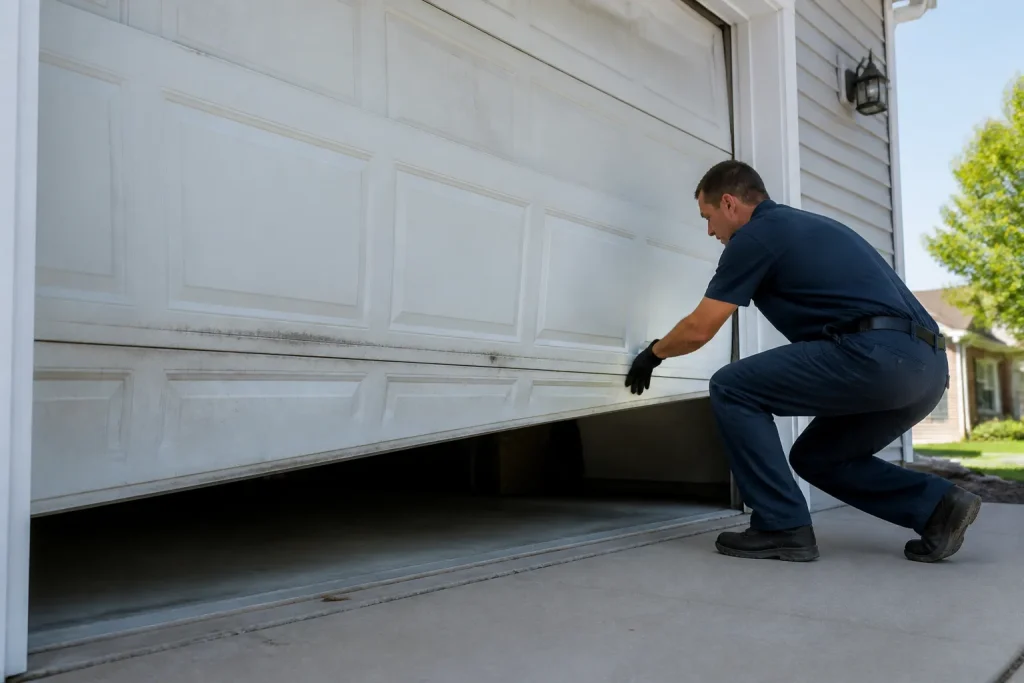
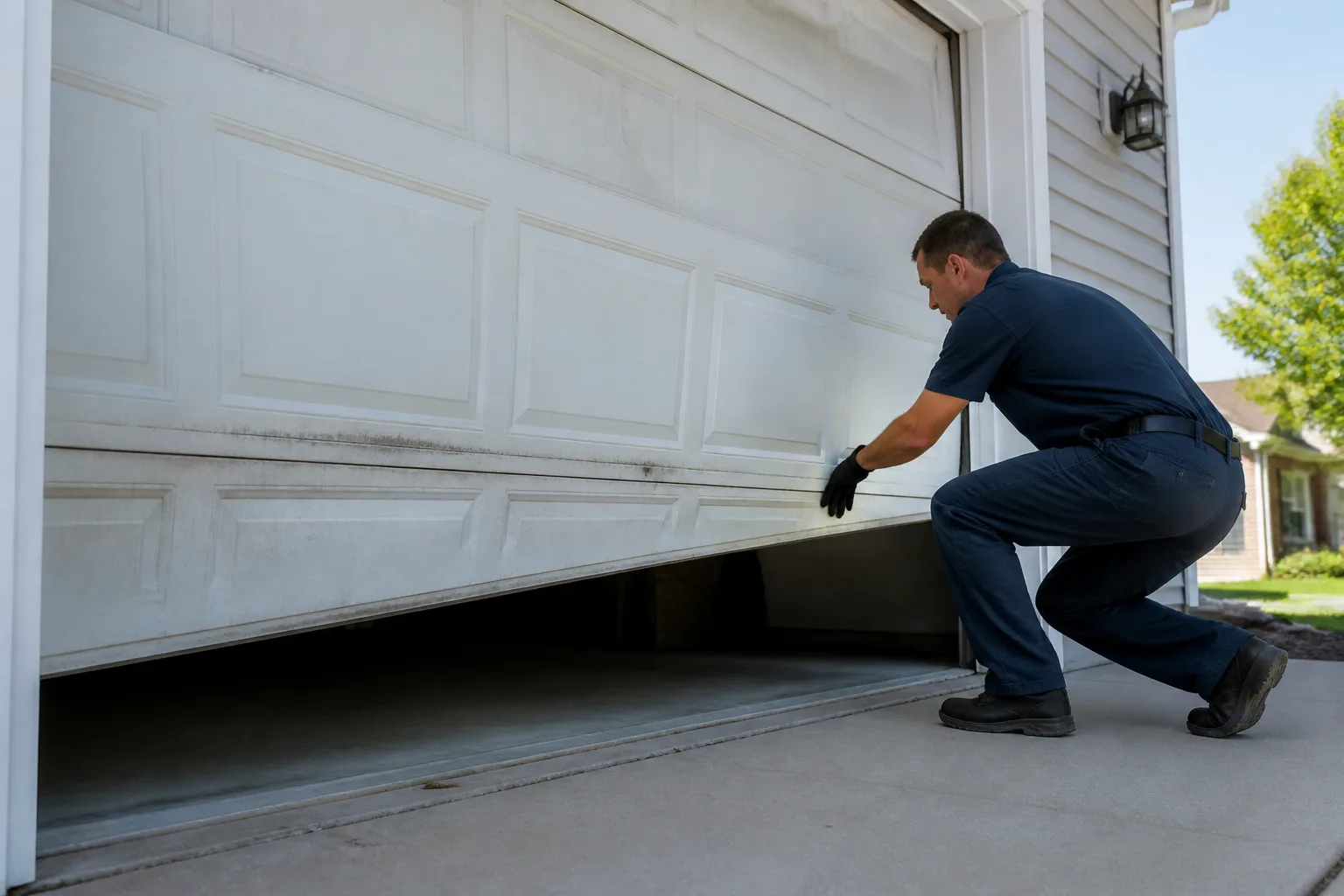
Look at where your door meets the floor. A healthy door sits flush across its full width. If it lifts on one side, binds, or the bottom seal shows uneven wear, you’re usually looking at a cable tension imbalance.
Why does that matter? Cables are what keep the door level as it travels up and down. When one cable is stretched, frayed, or off its drum, the door travels unevenly, which puts side loads on the tracks, wears out the rollers, and eventually bends a panel. Homeowners often spot the gap under the door first and assume the seal needs replacing. It’s rarely the seal. The seal is the messenger.
- Gap on one side, flush on the other: cable tension imbalance or a worn cable drum.
- Gaps uneven across the width: a warped bottom section or bent panel.
- Seal torn or flattened on one side only: the door is riding crooked, so the seal is taking more weight on that side.
Check the seal visually from outside once a month. It’s a 10-second look and it will tell you more about your cable health than anything you’ll spot from inside the garage.
Which Dents Are Cosmetic and Which Ones Mean Trouble
Not every dent matters. A panel with a shallow dent from a stray basketball is a cosmetic issue. It won’t affect how the door operates, and it’s a straight panel replacement if it bothers you. The dents that matter are the ones that have changed the panel’s shape in a way that affects how it sits in the track.
The tell is the edges. Run your hand along the vertical gap between panels on the dented section and compare it to an undented one. If the gap is wider on one side, or the panel is no longer flush with its neighbors, it’s warped. A warped panel pushes against the track as the door travels, which bends the track, wears the rollers, and eventually throws the whole door out of alignment.
For older doors, especially Clopay or Amarr panels that have been through years of temperature swings, small dents tend to turn into warps faster. If a dent has been there for more than a season and the door has gotten louder or rougher since, it’s probably not cosmetic anymore. A panel that’s warped but otherwise undamaged is often a repair. A panel that’s warped along with a bent track usually means a straighten-or-replace decision, and that’s a conversation worth having with a technician who works on that specific brand. Our garage door installation work covers full replacements when repair stops making financial sense.
What Princess Anne’s Salt Air Does to Your Door’s Lifespan
The air in Princess Anne carries more moisture and salt than inland towns, and that changes how fast metal parts wear. Springs, cables, hinges, and track hardware are all steel, and steel in this environment fatigues faster than it would twenty miles inland. We see springs fail years earlier here than the same spring would in a drier climate, and cables that look fine from above often have surface corrosion underneath.
What to check quarterly:
- Springs: Look for rust patches, especially where the coil ends meet. Rust means the spring is already weakened.
- Cables: Run a finger along the visible part of each cable. Fraying and surface rust are both signs to replace.
- Hinges and rollers: These take the salt exposure worst. Check for sticking or surface corrosion.
What to check annually:
- Panel finish: Look for bubbling paint or chalking on the bottom sections, usually a sign of moisture getting under the finish.
- Track alignment: A visual check for bends or gaps as the door travels.
- Opener motor: A listen for new strain in the motor during operation.
This is a real difference from what inland homeowners deal with. A Princess Anne door needs eyes on its metal parts more often, plain and simple.
When to Call a Pro Instead of Watching and Waiting
Some of what we’ve described is a watch-and-wait. Others isn’t. Call a technician if any of the following are true:
- The door hesitates or strains on every cycle, not just occasionally.
- You’ve heard a snap and the door is now heavy or won’t open.
- The balance test shows the door dropping or rising on its own.
- One side of the bottom seal has a clear gap.
- A dented panel is causing the door to drag or the track to bend.
Don’t force a door that’s showing these signs. A spring under tension or a slack cable is genuinely dangerous, and the fix is a few hours of trained work, not a YouTube session. Our technicians have up to 15 years of experience, and we work on Raynor, Chamberlain, Genie, LiftMaster, and several other major brands routinely, so whatever system is on the ceiling in your Princess Anne garage, we’ve seen it and know its failure patterns.
We diagnose before we quote. You’ll know what’s actually wrong before you decide what to do about it. If your opener is the part that’s failing, our garage door opener repair handles both legacy analog systems and modern Wi-Fi-integrated openers, so you don’t have to replace the whole unit just to get the smart-home features working.
Related services in Princess Anne: Garage Door Repair Princess Anne
The Bottom Line
The signs that matter most are the ones that are easy to dismiss: a half-second delay, a new grinding note, a gap under one side of the seal, a door that doesn’t hold its position during the balance test. Each one is the mechanical system telling you it’s under stress, and the stress compounds. Catching a stretched spring today is a spring replacement. Catching it after the opener motor has been working overtime for a month is a spring and a motor.
If you’re in Princess Anne and something on this list sounds familiar, Garage Door Repair Princess Anne offers free estimates. Call (844) 676-0048. We answer 24/7. Fast dispatch from 7am to 7pm, Sunday through Friday. One call covers the whole door, from the spring to the opener to the panel.
Frequently Asked Questions
A broken spring is usually obvious: you’ll hear a sharp snap, and the door becomes too heavy to lift by hand. A worn spring shows up as response lag, a door that won’t hold its position during the balance test, or a door that feels heavier than it used to. If you’re unsure, do the balance test. A door that drops instead of holding has a spring problem, and you should stop using the opener until a technician checks it.
Depends on the cause. A dry roller or a sticky hinge is a lubrication job most homeowners can handle. Response lag, grinding, uneven travel, or a door that doesn’t balance manually are not DIY territory. Springs and cables are under high tension, and an injury there is a serious one. Call a trained technician for anything mechanical, and let them diagnose the actual source before you decide what to do.
Check the springs, cables, and hinges visually every three months, and the panels and track annually. The salt air in Princess Anne accelerates metal fatigue, so quarterly visual checks catch spring rust and cable fraying before they become failures. The balance test is worth doing quarterly as well, or any time the door starts behaving differently.
A shallow cosmetic dent isn’t. A panel that’s warped and no longer sits flush in the track is a safety issue, because it puts side loads on the track and can cause the door to bind or come off its rollers. Check the vertical gaps between the dented panel and its neighbors. If they’re uneven, the panel has warped, and it’s time to have a technician look at it.
Call (844) 676-0048 for a free estimate. We diagnose before we quote, so you’ll know exactly what the door needs before any work starts.
Written by the team at Garage Door Repair Princess Anne.
Need Garage Door Help?
Call Garage Door Repair Princess Anne - the local pro we connect you with is licensed and insured, here with fast help in Princess Anne.
(844) 676-0048